




Search
When Test Data Changes the DHA: Ignition Sources That Are Easy to Miss
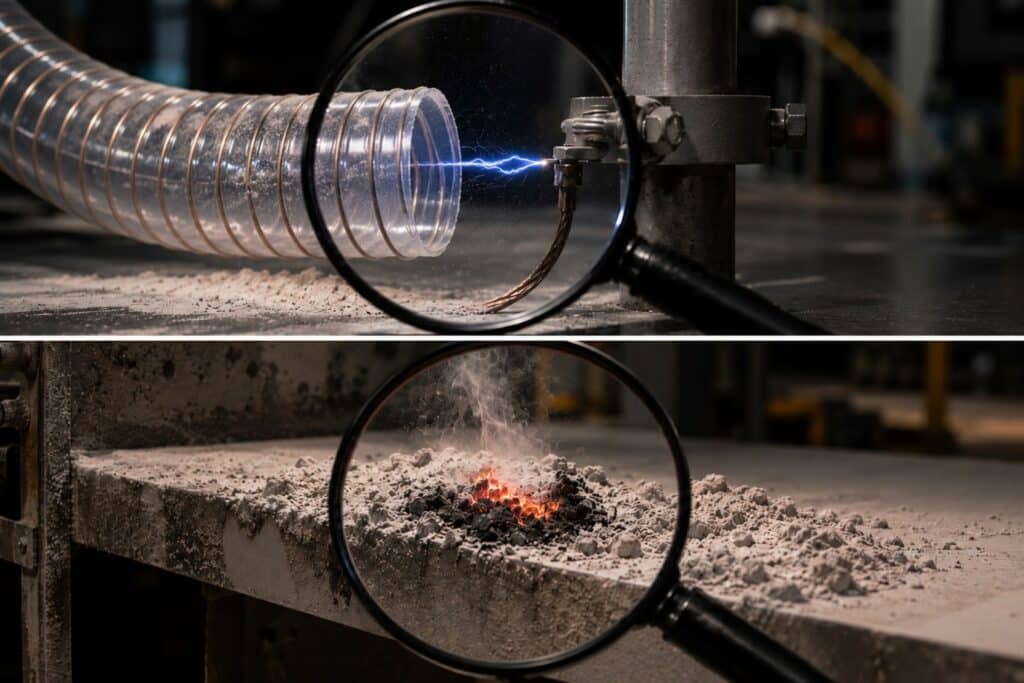
A Dust Hazards Analysis (DHA) should do more than list the familiar ignition sources. In this special article for Process Safety Dispatch, our powder combustibility specialists have put together their thoughts to help you ensure you do not miss those not so familiar but perhaps highly applicable ignition sources in your facility.
Hot work operations such as welding and cutting, open flames, arcs and sparks from electrical equipment, friction and grinding sparks from failed bearings, glowing embers, and even lightning all belong in the DHA discussion. In many facilities, these familiar ignition sources are already recognised and managed through inspection, maintenance, hot-work permits, operating procedures and area controls.
This article is not intended to replace that review. Its purpose is to look beyond the familiar list and consider the less obvious, and perhaps less visible, ignition pathways that can still manifest, particularly where the behaviour of the dusts or process conditions is not fully understood.
The more difficult question is this: do we know enough about the material, process, and equipment, in the way it is actually handled, to decide which ignition sources are truly credible?
That is where some DHAs show their vulnerability. Not because the hazard assessment team has ignored them, but because assumptions about the dust/ powder, or process conditions, have inadvertently been allowed to stand in place of evidence. In combustible dust safety, the ignition source that defeats the DHA is not always dramatic or obvious. It may be a warm surface, a discolored powder layer, an insulating hose, a charged plastic liner, a few charred particles carried into a dust collector, or a material that behaves differently (e.g., agglomerates or sticks to equipment surfaces) after each processing stage.
The value of laboratory testing is that it can challenge DHA assumptions before the plant does.
Want to understand the tests behind the DHA? Stonehouse Process Safety’s on-demand e-learning course, Exploding Dusts, explains the fundamentals of combustible dust behavior and introduces the key tests used to support Dust Hazard Analyses, including explosibility, ignition sensitivity, thermal and electrostatic testing. It is a practical way for engineers, EHS professionals and plant teams to understand what the data means — and why it matters. Sign up here: e-learning course
Go/No-Go testing: useful, but only the starting point
A standard Go/No-Go explosibility screening test is often the right first step to consider: can this powder, when dispersed as a dust cloud, support flame propagation or explosion? If the answer is “no”, that result can be very useful, provided the sample is representative of the material as handled and the test limitations are understood. If the answer is “yes”, the material should be treated as an explosible and combustible dust and the DHA must then ask a more detailed set of questions.
This distinction matters because some facilities, understandably, view the Go/No-Go result as the whole answer. It is not. A positive Go/No-Go result tells you that the dust cloud is explosible under the conditions of the test. It does not however tell you how easily the dust may ignite in the process, whether electrostatic discharges are credible, or what abnormal operating conditions could make the material more hazardous.
A negative result also needs care. It may apply only to the tested sample, with its particular particle size, moisture content, and condition. Fines found in a dust collector, dried material, milled product, recycled material or off-specification material may behave differently. The DHA should therefore ask whether the Go/No-Go sample was the right sample, and whether it represents the most hazardous form likely to be present in the process. Importantly, a negative result also does not tell you whether the powder is combustible, i.e., a fire hazard – for example, whether settled dust could begin to smoulder on warm surfaces or catch on fire with a competent ignition source and propagate flame.
Hot surfaces – dust clouds and dust layers raise different questions
Hot surfaces can matter in more than one way, so the DHA should first identify where elevated surface temperatures may arise (considering normal and abnormal conditions) and then distinguish between the different ignition mechanisms.
The important point is that the same hot surface may present different hazards depending on whether it is exposed to a dispersed dust cloud, a settled dust layer, or both:
Dust clouds
For a dispersed dust cloud, the relevant question is whether the cloud can directly ignite when it comes into contact with a sufficiently hot surface. Minimum Auto-Ignition Temperature (MIT-cloud) testing for dust clouds, broadly analogous to an ‘auto-ignition’ temperature test, helps inform this part of the assessment. This is directly relevant where dust clouds may be exposed to hot process vessels such as dryers, mechanical equipment such as hammer mills, or electrical equipment under normal or abnormal operating conditions.
Power Layers
Settled powder and dust layers behave differently. A layer on a beam, motor casing, dryer surface, mill housing, or other warm surface may not ignite explosively. Instead, it may heat gradually. If the layer begins to oxidise, char, smoulder, thermally degrade, or generate heat faster than it can lose it, it can become a persistent ignition source. That smouldering material may then be disturbed and eventually lead to ignition of a dust cloud.
Minimum ignition temperature testing for dust layers is therefore not simply another version of dust cloud ignition testing. Layer Ignition Temperature – LIT – helps answer a different question: can a powder deposit on a warm surface heat, ignite, char, or smoulder, and could that deposit then create a secondary ignition source?
The distinction between dust cloud ignition and dust layer ignition matters. Dust layer ignition temperatures are usually (much) lower than dust cloud ignition temperatures. A surface temperature that is too low to ignite a dust cloud directly may still be high enough, given sufficient time and layer thickness, to initiate charring or smouldering in a dust deposit. A process may therefore have little credible direct cloud-ignition risk from exposure to a hot surface yet still have dust accumulation on warm equipment that creates a credible dust layer ignition risk.
The DHA should therefore avoid treating “hot surfaces” as a single ignition-source category. It should ask separately: where can hot surfaces arise, can a dust cloud contact those surfaces, can dust layers accumulate on them, and could a smouldering deposit later ignite a dust cloud? Appropriate laboratory tests on representative powder samples help answer these questions.
When material state changes the answer
A DHA should ask whether the material being tested is actually the material being handled. Powder physical properties such as particle size and moisture content will often change during normal processing, for example through drying, milling, blending, sieving or recycling. They can also chemically change unexpectedly through contamination, ageing, degradation, off-specification production or process upset.
These changes can affect explosibility and dust cloud ignition behavior. A powder that gives a negative or marginal Go/No-Go Explosibility result in one form may become explosible after drying, milling, sieving, or attrition. A powder with a high moisture content may be difficult to ignite, while the same material after drying may have a lower minimum ignition energy (MIE) or minimum auto-ignition temperature (MAIT-cloud). A coarse product may be less sensitive than fines generated during handling, milling, or collected in a dust collector. Changes in particle size, moisture content, and composition can also affect Kst and Pmax. The material most worth testing may therefore be the driest, finest, or most readily dispersed form present in the process, not simply the normal finished product.
Thermal stability again, a related issue. Here the concern may not be an external hot surface, but heat generated within the material itself. Self-heating or exothermic decomposition may be relevant after drying or any other process that might heat up the powder such as mechanical milling and then subsequent storage in bulk bags, IBCs, drums, bins, silos, and hoppers. Thermal instability or self heating may arise from presence of residual solvent, oil, catalyst, or reactive impurities, or biological activity – or simply from an inherent property of the material that needs to be understood before processing.
Bulk quantity matters. A small sample may appear stable while a larger mass retains heat more effectively and loses heat less readily. As the stored bulk size increases, the onset temperature at which self-heating becomes possible can reduce. Storage volume, container size, hold time, insulation, ventilation and cooling conditions can therefore all change the hazard level.
Testing should simulate the material state and the heating scenario. For dust cloud hazards, MIE, MIT cloud, particle-size analysis, moisture-content measurement, and testing of representative worst-case samples may be needed. For bulked or stored materials, screening and isothermal self-heating / thermal instability testing, may be more relevant. A DHA that relies on test data from the wrong material state can miss the condition that matters most. The question is not simply “has this material been tested?” It is “has the right form of the material been tested for the way it is actually handled?”
Static electricity: more than “bond and ground”
Static electricity is often included in DHAs, but sometimes too generically. “Bond and ground all conductive equipment” is sound advice, but it is not a complete solution – and it certainly does not constitute an electrostatic risk assessment.
Grounding only works where charge is able to actually move to ground. It does not solve every problem created when using insulating plastics, liners, hoses, sight glasses, coatings, flexible connectors, gaskets, bags, scoops and portable containers. Nor does it necessarily address powders that charge readily during operations such as transfer/conveying, sieving, or milling.
The DHA needs to consider how the static charge might be generated and what type of electrostatic discharge could occur. “Spark” discharges from isolated conductive, e.g., metal items are one concern. “Brush” discharges from insulating surfaces are another. “Cone” discharges can occur during the filling of larger containers. “Propagating Brush” discharges, although less common, can be highly energetic and are associated with certain insulating layers and surfaces.
This is where electrostatic testing and assessment become valuable. Minimum Ignition Energy (MIE) testing helps establish how sensitive the dust cloud is to ignition. Powder volume resistivity and electrostatic chargeability testing can help assess whether charge is likely to accumulate on the powder, even if it is handle and stored in all grounded metal equipment. Surface and volume resistivity measurements can support decisions about hoses, liners and flexible components. For FIBCs, the type of bag must be suitable for the powder material and the environment.
A useful question for the DHA team is: Where could charge accumulate that grounding will not remove?
That question often leads to a better discussion than simply asking whether the plant equipment is grounded.
Abnormal operation is often where the hidden ignition source appears
Many combustible dust incidents occur when the process is not behaving normally. Start-up, shutdown, cleaning, maintenance, blockages, product changeover, loss of cooling, loss of ventilation, dryer upset, overfilling, and temporary equipment can all alter the ignition-source picture.
A dryer may be safe under normal residence time but not if material is hot during a stoppage. A conveying system may be acceptable when flowing freely but not during a blockage. A dust collector may be protected during normal operation but vulnerable if maintenance procedures introduce unassessed ignition sources. A flexible hose may be suitable in one location but not when moved to a temporary transfer duty.
What testing can add to the DHA
Testing should not be treated as a box-ticking exercise. The aim is not to produce a thicker appendix. The aim is to make the DHA focused and more accurate.
A well-designed testing program can help answer pertinent questions: Is the powder explosible in a standard Go/No-Go test? This may be the starting point, but rarely provides all the answers. If it is explosible, how severe could the explosion be? Can the dust cloud ignite by credible process ignition sources? Can settled dust ignite on warm equipment? Can deposits self-heat or smolder? Are electrostatic discharges credible ignition sources? Is the tested sample representative of the material state actually present throughout the whole process? Could normal changes brought about by drying, milling or attrition, or abnormal changes such as contamination, create a more hazardous material?
Not every process needs every test. A competent DHA should select testing based on the material, the equipment, the operating conditions and the credible abnormal scenarios. But where the ignition-source assessment depends on an untested assumption, testing may be the difference between a robust DHA and a vulnerable one.
Not sure whether you have the right test data? Stonehouse encourages early technical discussion before testing is commissioned. A short conversation about the material, process, equipment and credible upset conditions can help identify which data are already sufficient, which assumptions need checking, and which combustible dust tests are most likely to add value to the DHA. Contact us for a discussion on selection of appropriate tests and application of test results to your process.
Summary: The ignition source you do not see
The most dangerous ignition source is not always the one everyone can see. Sometimes it is hidden in the material’s behaviour: the layer that smoulders, the powder that self-heats, the plastic surface or insulating powder that accumulates charge, the fines that ignite more easily than expected, or the abnormal operating condition that changes everything.
A strong DHA recognises that combustible dust hazards are defined by the interaction of the material, the process, the equipment and the operating conditions. Thermal, electrostatic and representative-sample testing are especially valuable because they often reveal hazards that are not obvious from visual inspection or from explosion severity data alone.
The purpose of testing is not to complicate the DHA. It is to make it harder to fool.
DHA support from testing through interpretation. Stonehouse can provide a complete Dust Hazard Analysis service, including selection of appropriate combustible dust tests, interpretation of results, ignition-source review, and integration of the findings into practical DHA conclusions and recommendations. Where clients already have a DHA, Stonehouse can also review whether the test data and assumptions are strong enough to support the conclusions. Contact to discuss having a Stonehouse specialist undertake your DHA.

Get in touch
To learn more about our expertise and services in dust explosion prevention & mitigation, call us at +1 609 455 0001 or email us at [email protected] today.
We also offer tailored virtual and in-company process safety training programs on Dust Explosions, Static Electricity and HAC (Hazardous Area Classification) and more. Find further information here.