




Search
Don’t Let Your DHA Run on Assumptions: What Testing Adds to a Dust Hazard Analysis (DHA) That Judgment Alone Can’t
A Dust Hazard Analysis (DHA) according to NFPA 660: Standard for Combustible Dusts and Particulate Solids is the systematic, engineering-driven process that identifies where fire and explosion hazards exist in your facility and what it will take to control them. It’s a rigorous analysis in its own right – and like any rigorous analysis, it’s only as strong as the data it’s built on.
That’s where testing comes in. It supplies the documented, material- and process-specific data that supports the DHA’s conclusions, and it’s what lets the DHA team move past a single Go/No-Go result into a full picture of the hazard.
A thorough DHA works through a series of questions, each pointing to a different piece of testing or process data. Below are ten of the big ones – not a fixed test package, but a checklist for scoping testing to your material, your process conditions, and your credible upset scenarios.
We already ran a Go/No-Go test – is that enough?
On its own, no – though it’s an important building block. A Go/No-Go result confirms one specific thing: whether a dispersed cloud of your powder can propagate an explosion. It doesn’t give the DHA team what they need to address severity, ignition sensitivity, layer or self-heating hazards, or whether the sample tested even represents what’s moving through your process on a bad day. Those are separate determinations, each covered in the questions below, and each needs its own supporting data before the DHA can rely on it.
Is my powder explosible?
This is the question Go/No-Go screening is built to answer, and it’s the right place for testing to start. A positive result confirms that a dispersed cloud of your powder can sustain and propagate an explosion – the foundational determination the rest of the DHA builds on. It’s a yes/no result, though, which is exactly why the questions that follow are what turn it into a complete picture.
Tests / data that can help answer it:
- Go/No-Go explosibility screening
- Particle size analysis
- Moisture content
If my powder is explosible, how does testing help define how severe it could be?
Once you know an explosion is possible, the next question is how bad it could get. Severity data defines the pressure and rate of pressure rise you’d need to design against – it’s what turns a hazard finding into an actual protection strategy, whether that’s venting, suppression, containment, or isolation.
Tests / data that can help answer it:
- Kst (deflagration index)
- Pmax (maximum explosion pressure)
- Explosibility (dust hazard) classification
- Data supporting venting, suppression, containment, and isolation design
Can combustible dust testing tell us which ignition sources actually matter?
A powder can be explosible and still be hard to ignite – or it can be sensitive enough that a weak spark sets it off. That sensitivity determines which ignition sources actually matter for your process: static discharge, friction, impact, hot surfaces, or electrical faults.
Combining test data with a process-specific ignition source assessment helps you focus safeguards on credible ignition scenarios, rather than treating every potential ignition source as equally likely or equally hazardous.
Tests / data that can help answer it:
- Minimum Ignition Energy (MIE)
- Minimum Ignition Temperature – dust cloud (MIT cloud)
- Process-specific ignition-source review
Do we need separate data for dust that’s already settled on warm equipment?
Dust clouds and dust layers don’t behave the same way. A hot surface that’s perfectly safe around an airborne cloud can still slowly heat, char, smolder, or ignite a layer of dust that’s settled and accumulated on it. If your process has warm equipment and any accumulation at all, this is a separate question from cloud ignition – and it needs its own answer.
Tests / data that can help answer it:
- Layer Ignition Temperature / MIT layer
- Hot-surface assessment
- Dust layer thickness and accumulation review
Can testing catch ignition sources the DHA team wouldn’t otherwise think to look for?
Yes, and this is one of the clearest examples of testing extending what a DHA can identify. Deposits, bulked powder, or material retained in the process — especially after drying, heating, milling, or storage — can generate enough heat on their own to become an ignition source, with no external spark or flame to point to. Thermal testing is what brings this hazard into the analysis, since there’s no obvious external trigger for the DHA team to flag on process knowledge alone.
Tests / data that can help answer it:
- Thermal stability screening
- Differential Scanning Calorimetry (DSC)
- Isothermal self-heating tests
- Basket tests
- Hot-storage simulations
Are electrostatic discharges something our DHA needs testing to address?
Usually, yes. Bonding and grounding are essential controls, but they have limits: they don’t remove charge from insulating materials, and they don’t prevent every type of electrostatic discharge. Whether static is a credible ignition scenario for the DHA to carry forward depends on the powder’s own properties and on the equipment it contacts — liners, hoses, flexible connectors, and bulk bags all matter here, and testing is what quantifies that risk for the DHA.
Tests / data that can help answer it:
- Minimum Ignition Energy (MIE)
- Powder volume resistivity
- Chargeability testing
- Surface/volume resistivity of liners, hoses, and flexible parts
- FIBC (bulk bag) assessment
Does it matter which sample we test, or does any DHA-supporting data work?
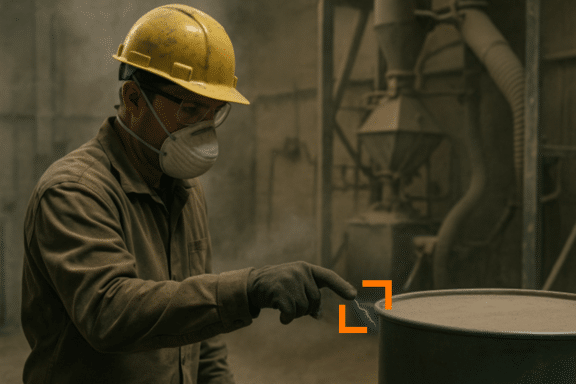
It matters more than almost anything else on this list, because it underpins every other answer in the DHA. It’s tempting to test whatever sample is easiest to get, usually the finished product. But the finished product isn’t always the worst case. Fines, dried material, recycled material, dust collector fines, or off-spec product can all be meaningfully more hazardous than what ships out the door. Testing the wrong sample means the DHA’s conclusions — however well-reasoned — are built on the wrong foundation.
Tests / data that can help answer it:
- Particle size analysis
- Moisture content
- Representative worst-case sampling
- Comparison across feed, product, fines, dust collector material, and intermediates
Our process changes the material — does the DHA need to account for that too?
It should. A DHA reflects the material and process conditions understood at the time it’s performed, but processes aren’t static. Drying, milling, attrition, ageing, contamination, degradation, and process upsets can all shift a material’s explosibility, ignition sensitivity, thermal behavior, or electrostatic properties, sometimes significantly. Testing lets the DHA reflect not just what your material does today, but what it could become under conditions your process will eventually see.
Tests / data that can help answer it:
- Repeat Go/No-Go testing on changed material states
- MIE
- MIT cloud
- MIT layer
- Kst and Pmax
- Thermal stability and electrostatic testing
How often does the testing behind our DHA need to be refreshed?
On a defined cycle, not only when something obviously changes. NFPA 660 requires DHAs to be revalidated at least every five years, in addition to being updated whenever a significant process, material, or equipment change occurs in between. A revalidation is generally a lighter-weight exercise than the original DHA, but it still needs to confirm that the testing behind it reflects your current material and process, and scope new testing where it doesn’t.
For a closer look at what triggers a revalidation and what it typically involves, see our guide to NFPA 660’s five-year revalidation rule.
A revalidation typically involves:
- Review of process, material, and equipment changes since the last DHA
- Confirmation that existing test data (Go/No-Go, Kst/Pmax, MIE, and related results) still reflects current conditions
- Targeted retesting where materials, formulations, or processes have changed
- Comparison against current standards and regulatory requirements
| DHA Question | Tests That Strengthen the Answer |
| Is the powder explosible? | Go/No-Go explosibility screening; Particle size analysis; Moisture content |
| If the powder is explosible, how does testing help define how severe it could be? | Kst (deflagration index); Pmax (maximum explosion pressure); Explosibility (dust hazard) classification; Supporting data for venting, suppression, containment, and isolation design |
| How does testing help the DHA determine which ignition sources actually matter? | Minimum Ignition Energy (MIE); Minimum Ignition Temperature – dust cloud (MIT cloud); Process-specific ignition-source review |
| Does the DHA need separate data for dust that’s already settled on warm equipment? | Layer Ignition Temperature / MIT layer; Hot-surface assessment; Dust layer thickness and accumulation review |
| Can testing catch ignition sources the DHA team wouldn’t otherwise think to look for? | Thermal stability screening; Differential Scanning Calorimetry (DSC); Isothermal self-heating tests; Basket tests; Hot-storage simulations |
| Are electrostatic discharges something our DHA needs testing to address? | Minimum Ignition Energy (MIE); Powder volume resistivity; Chargeability testing; Surface/volume resistivity of liners, hoses, and flexible parts; FIBC (bulk bag) assessment |
| Does it matter which sample we test, or does any DHA-supporting data work? | Particle size analysis; Moisture content; Representative worst-case sampling; Comparison across feed, product, fines, dust collector material, and intermediates |
| Our process changes the material – does the DHA need to account for that too? | Repeat Go/No-Go testing on changed material states; MIE, MIT cloud, and MIT layer; Kst and Pmax; Thermal stability and electrostatic testing; Moisture and particle size testing |
| How often does the testing behind our DHA need to be refreshed? | Review of process, material, and equipment changes since the last DHA; Confirmation that existing test data (Go/No-Go, Kst/Pmax, MIE, and related results) still reflects current conditions; Targeted retesting where materials, formulations, or processes have changed; Comparison against current standards and regulatory requirements |
Final Thoughts
Testing doesn’t replace the DHA, and it was never meant to. The DHA is what determines which tests are actually needed, how the resulting data should be interpreted for your specific material and process, and what safeguards follow from it. What testing does is give the DHA team a documented, material-specific technical basis in place of worst-case assumptions.
A Go/No-Go result confirms explosibility and little else. A DHA supported by severity, ignition sensitivity, layer and self-heating behavior, electrostatic, and representative-sample testing is a fundamentally stronger, more defensible analysis – one built on evidence rather than assumption.
Having a current, well-supported DHA is also an excellent foundation for wider hazard studies, so it’s worth investing in the right testing the first time.
Need Testing to Strengthen Your Dust Hazard Analysis?
At Stonehouse, we help clients determine which tests their DHA actually needs, then scope, commission, and interpret that testing – from Go/No-Go screening through severity, ignition sensitivity, layer and self-heating behavior, and electrostatic testing – so the data strengthens the specific conclusions your analysis depends on, rather than filling out a generic checklist.
We also advise on sampling strategy, help interpret results in the context of your process conditions and credible upset scenarios, and support the wider DHA and explosion protection design that follows.
Get in touch to learn more about how our testing services support and strengthen your dust hazard analysis, along with our training and fire and explosion hazard assessment support: Contact us | Request a quote

Get in touch
To learn more about our expertise and services in dust explosion prevention & mitigation, call us at +1 609 455 0001 or email us at [email protected] today.
We also offer tailored virtual and in-company process safety training programs on Dust Explosions, Static Electricity and HAC (Hazardous Area Classification) and more. Find further information here.